Stress Physiology and Yoga
#goodMorningSunshine ?
#morningsAreBeautiful ?
#rituals of #theBeautifulJourney 
This is week #15 of twice daily exercise started during lockdown. Mornings are dedicated to yoga, evenings to a mix of types of exercises.
The evenings are continuing with Heather Robertson’s 12 week program, this having been the 6th week. On top of that I add my own selection of other training videos focusing on a particular muscle area so that across a week I cover all major groups.
The mornings this week were dedicated to a course by Valerie Knopik on Stress Physiology and Yoga. I also started looking into breathing techniques – a pranayama practice by Shari Friedrich and an intro to diafragmatic breathing by Rolf Sovik.
Valerie Knopik’s course talks about all aspect of stress, including positive stress – eustress – and the role of the vagus nerve in our wellbeing and stress management and how yoga, pranayama, meditation and other practices can help stimulate this nerve. More below.
Breathing techniques
Following the recommendation, I’ve only practiced a couple of breathing techniques this week. The rest should be explored incrementally, each week. The two that I have done at the end of the morning practice were:
- Kapalabhati (Skull Shining) – clear the mind, cleansing; strong exhalation, passive inhalation – 11 breaths, twice
- Bhastrika (Breath of Fire) – digestion, core and diaphragm strength; strong and quick inhalation and exhalation, start on rapid exhale, stop on rapid inhale – 11 breaths, twice
I did not practice diaphragmatic breathing this week. But this is the type of breathing that I used to use during my meditation sessions, which is something I am not doing at the moment. I do have a Headspace yearly subscription and used to meditate daily, following the various programs they offer e.g., after Basics, the ones I’ve done on my journey were on…
- Balance
- Creativity
- Appreciation
- Happiness
- Self-Esteem
- Relationships
- Acceptance.
With Headspace it is nice that if you meditate for at least 15 days in a row, you can then offer a one month free access to Headspace to someone. I’ve given this gift to someone who claimed it on Twitter where I’ve offered it.
So, diafragmatic breathing is my choice of breathing during meditation. According to Rolf Sovik, the diafragmatic breath should be…
- deep
- smooth
- equal
- without pause
- without sound
Stress physiology and Yoga
This course covers a bit of theory so I decided to design my own yoga flow that would be easy enough to allow me to focus on the knowledge shared in the course. It was nice, I felt good about the fact that I am doing my own thing. Then continued with the practice proposed by the course.
Here are some key words:
Stress = function(demand from a stressor, amount of compensation to keep the system in homeostatic limits)
Homeostasis = regulation of stability of the internal environment by an organized system of control
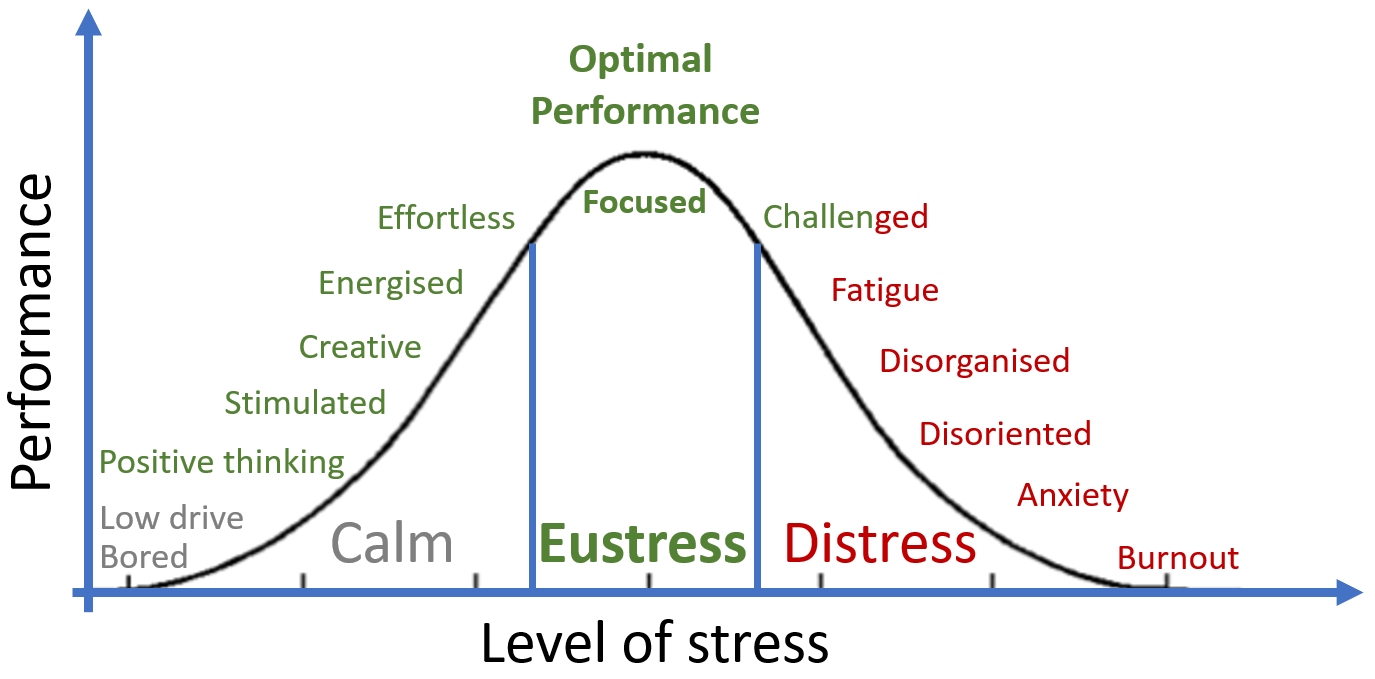
Remember that there is both positive and negative Stress:
- Eustress – positive – when we are in our optimal performance zone
- Distress
Here is a picture I’ve put together of the two concepts:

The course also covered …
- the notions of acute and chronic stress and how living in the past or the future, anywhere but the present moment, influences both of those forms of stress.
- stressors in the internal and external environment of a person
- body responses to stress in…
- the nervous system
- the endocrine system
- the central stress response system: the HPA axis
- HPA axis supports a longer stress response, if it is needed:
- Hypothalamus
- Pituitary
- Adrenal glands
- HPA axis supports a longer stress response, if it is needed:
Some details on the nervous system:
- peripheral somatic nervous system – the nerves connect to the muscles – see The somatic experience
- peripheral autonomic nervous system – controls automatic bodily functions
- Sympathetic – Fight, Flight, Freeze
- Parasympathetic – Rest & Digest
- connected to the vagus nerve, the wandering nerve that runs across the body and the back of the throat
- stimulate the vagus nerve through …
- pranayama (breathing exercises)
- chanting
- feelings of social support
- meditation
- restorative or yin yoga
- yoga poses where you stimulate the neck
- grounding vinyasa
This has been week #15 of daily exercise started during lockdown.
#theBeautifulJourneyWithiuliana
And here is another one of my weekly paintings. Here is the video that inspired me.
