The somatic experience
#goodMorningSunshine ?
#morningsAreBeautiful ?
#rituals of #theBeautifulJourney 
This week had a different rhythm, mornings were quite slow, like a meditation through movement, while the evenings remained as intense as always.
One of the morning classes was about the somatic experience which brings a focus on the lived experience of the body and the subtle energy.
Through awareness one can reduce effort, create ease, efficiency, conserving energy and improving skill.
This week’s classes have barely scratched the surface on the subject of somatic experience, leaving so much more to study and practice.
The names and ideas associated with this field in some form or other were mentioned. Thomas Hanna as the founder of Somatics, then you have Moshe Feldenkreis that taught Hanna’s Functional Integration program and then developed his own method focusing on self-awareness through movement, on the importance and influence of unconscious intention and attention on movement. Rudolf Steiner that inspired Waldorf education and Maurice Merleau-Ponty are mentioned as well.
Laban movement analysis was brought up when discussing environment and action. We practiced The Satisfaction Cycle i.e. the 5 actions that define a movement:
-
- yield
- push
- reach
- grasp
- pull
Not all yoga poses have a grasp and pull action, but I wonder if this is achieved by engaging the pelvic floor (Mūla Bandha). Some yoga classes instruct to engage the pelvic floor, but not many of the beginner and intermediate ones I’ve seen so far.
The topic of somatic experience made me think of the Szondi test and its use. This a 1935 nonverbal projective personality test developed by Hungarian psychiatrist Léopold Szondi. The intent of the test is to reveal unconscious thoughts, desires and impulses on the basis of sympathy or aversion. It considers that an imbalance of the impulses can create a mental imbalance or disorder.
The usefulness of the test and the extraordinary ability of the body to store information that we’re not consciously aware of, is wonderfully visible in inmate studies. In an evaluation for e.g. release on probation, an inmate may say, and in their mind also believe, that they won’t commit crimes again. Yet, a Szondi test often reveals that the problematic impulses and their imbalance is still present. The person though, cannot perceive the disconnection between their mind and their body. They are so familiar with what their body is feeling, that to them it just feels ok.
On a less dramatic and socially dangerous tone, it can be said we all experience a degree of disconnection between what right means in the mind and what right means in the body. For example, bad posture. Your mind might be telling you that you’re upright in a good posture, but your body isn’t and that is because it is so familiar with certain positions, that they feel natural and ok, so there is no perception that an adjustment should be made.
And this leads me to the Alexander technique mentioned in the somatic experience course. The Alexander technique is as much about unlearning and it is about learning given its focus is on retraining habitual patterns of movement and posture. For this kind of work, self-awareness is key. Frederick Matthias Alexander, the Australian actor who developed the technique, reinforces the point by saying that the technique is a mental training as well.
Then we also have ideokinesis – the use of visualization, imagery to inspire posture, alignment and fluency of movement – founded by Mabel Todd and described in her book The Thinking Body. This approach is used a lot in dancing where it is also know as “the Work”. The work was taken further by Lulu Sweigard.
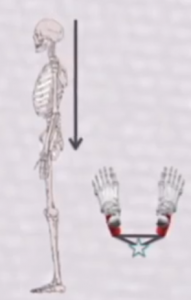
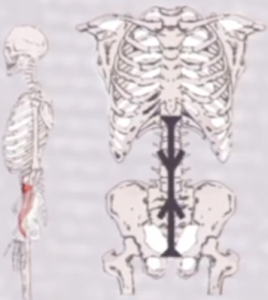
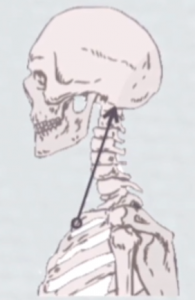
When talking about ideokinesis, you’ll come across the 9 lines of movement, which are abstractions, a “theoretical force moving along an imaginary straight line” (Sweigard):

1. Spine lengthening down
-
- start from mid sacrum with a line down to the floor behind your heels. This points forms a triangle with the other two points being the heels. Lumbar spine lengthens downwards.
2. Mid front of the pubis to T12 (pelvis alignment)
-
- shortens the distance between front of pelvis and T12
3. Sternum to the top of the spine (head alignment)
4. Widening the shoulders, narrow the rib cage
5. Widen across back of pelvis
-
- spread width-wise the hip crests at the back, next to the sacrum, and down to the greater trochanter of femurs
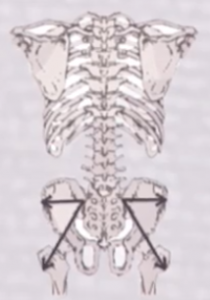
6. Narrow across front of pelvis
-
- from the ASIS of both hips, bring a line inward to meet at the mid-line of the body.
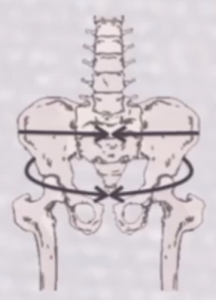
7. Center of knee to center of hip (alignment)
8. Big toe to center of heel (balances arches and tripod of foot)
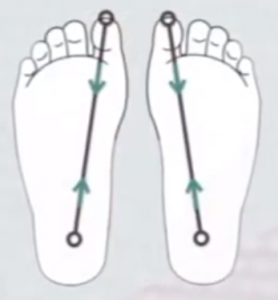
9. Central axis upward (put everything together)
It was also fun to go through the topic of automatic movement. It the same principle as in automatic writing, if you are more familiar with that. I moved in ways that made me giggle. Felt good.
I’m not sure if it is this week or all these weeks put together, but I have been feeling so much better, so much happier lately, for the simple aspect of being or the wondrous aspect of being.  And I enjoy the practice I am currently doing.
Evenings continue with Heather’s program, to which I add my extra choice of training videos, otherwise it doesn’t feel enough. The weekend is not covered with the program, so for that I select one hour long yoga classes. Plus the dancing.
Now I need to start thinking how to adapt this practice and all the other rituals I’ve set in during these weeks once the rhythm of the world around me changes.
The morning yoga sessions are easier to keep than the evening ones.
Until next time … stay attentive to your body!
This has been week #10 of daily exercise started during lockdown.
#theBeautifulJourneyWithiuliana
Resources and images:
- https://www.youtube.com/watch?v=T0PC8Ba2Rvs
- http://gregdyke.github.io/2016/06/15/100-days-of-franklin-week-3.html
- https://prezi.com/8xqjgsyohwyp/9-lines-of-movement/
- Imaginary Movement, Ideokinesis – by Richard Rosen
One thought on “The somatic experience”